
Deflection, Containment, Resolution: Three Metrics Teams Keep Confusing
A benchmark is only as honest as its definitions. These three automation metrics get used interchangeably, and the slippage quietly inflates every number that follows.
Ask three vendors for their "resolution rate" and you will get three numbers that are not measuring the same thing. Ask three teams inside the same company and you may get the same problem. Deflection, containment, and resolution are distinct concepts with distinct denominators, and treating them as synonyms is the most common way a contact-center automation benchmark ends up overstating its case — usually without anyone intending to mislead.
Getting the definitions right is not pedantry. It is the precondition for every downstream comparison. If you cannot say precisely what a number counts, you cannot compare it across vendors, across channels, or across quarters. Here is how we separate the three, and where the slippage tends to hide.
Three definitions, three denominators
Deflection measures contacts that never reached a human channel because the customer's need was met earlier — in an IVR, a chatbot, a help-center article, or an app flow. The denominator is attempted contacts, and the metric is fundamentally about diversion. Its weakness is that deflection is silent about outcome. A customer who abandons in frustration and a customer who found their answer both look identical to a naive deflection counter.
Containment measures contacts that stayed within an automated channel through to the end of the session, without escalating to a human. The denominator is contacts entering the automated channel. Containment tells you the automation held the conversation. It does not, on its own, tell you the conversation ended well. A contained session can still be a failed one if the customer gave up.
Resolution measures contacts where the customer's underlying need was actually met. The denominator should be contacts with a resolvable intent, and the measurement should be tied to a real signal — no repeat contact within a defined window, a confirmed transaction, or an explicit confirmation from the customer. Resolution is the only one of the three that speaks to outcome, and it is the hardest to measure honestly.
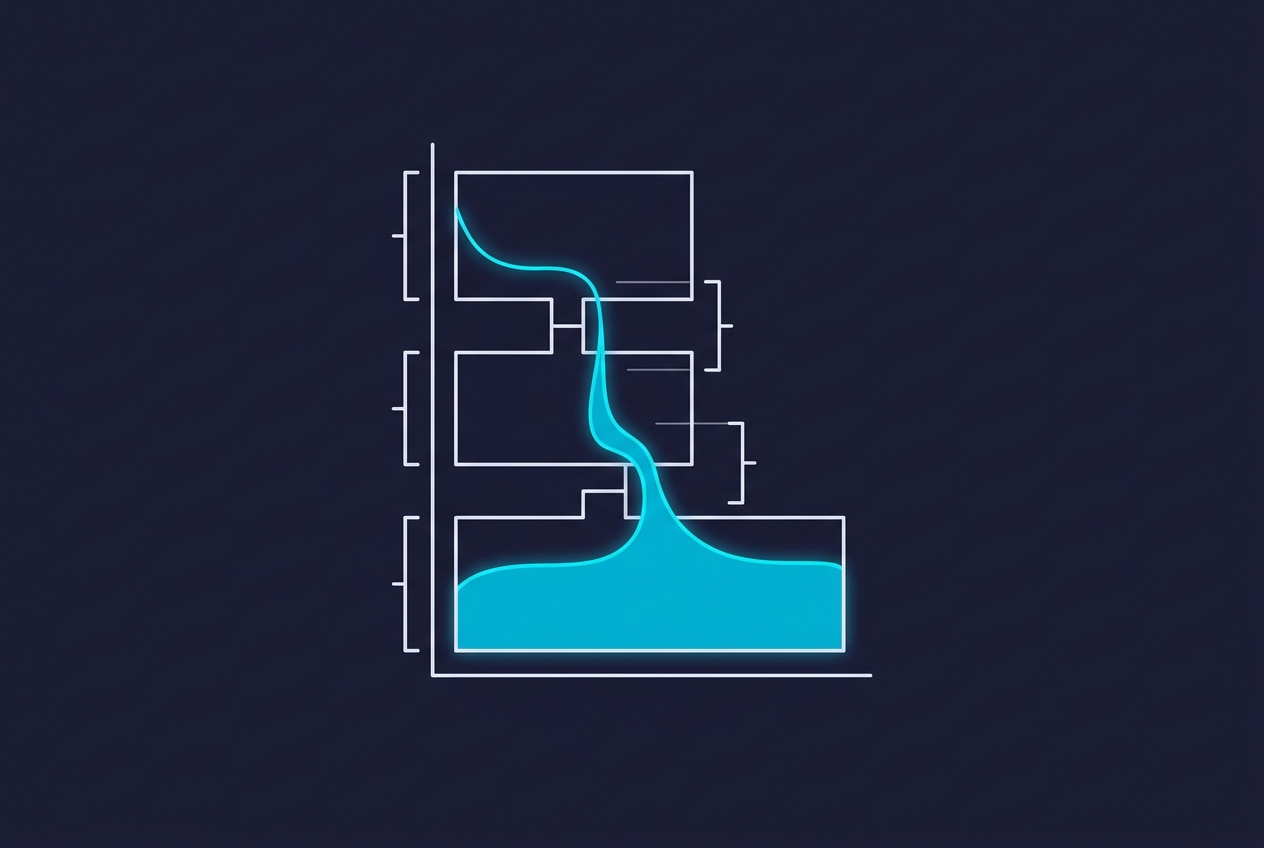
The relationship among them is a funnel, not a set of interchangeable labels. Deflection is the widest and cheapest to claim; resolution is the narrowest and most meaningful. Every step down the funnel, the number gets smaller and the claim gets stronger.
Where the slippage happens
The inflation is rarely a single fabricated figure. It is a chain of small, defensible-sounding choices that each nudge the number up.
- Counting abandonment as success. If a customer drops out of a chatbot and never calls back, a crude system records containment and, worse, sometimes resolution — the absence of a follow-up contact gets read as a solved problem rather than a lost one.
- Choosing a forgiving window. "No repeat contact" resolution depends entirely on the window. A one-hour window will always look better than a seven-day window, because many customers who were not actually helped simply try again the next day.
- Filtering the denominator quietly. Excluding "out of scope" contacts, misroutes, or contacts the automation was never expected to handle shrinks the denominator and lifts the rate. Sometimes that is legitimate; often it is undocumented.
- Sliding from one term to another. A deck reports an impressive deflection number and then, a slide later, describes the same figure as resolution. Nobody lied. The label just drifted, and the drift is worth a large multiple.
The fastest way to audit an automation claim is to ask one question: what is the denominator, and what happened to the customers who are not in the numerator? If the answer is vague, the number is decorative.
A discipline for honest measurement
You do not need sophisticated tooling to measure these three cleanly. You need to commit to definitions in advance and instrument for outcome, not just for events. A workable standard:
- Pick one resolution signal and one window, and publish both. If resolution means "no contact about the same intent within 72 hours, and no agent-logged reopen," say so everywhere the number appears.
- Report the three as a funnel, not in isolation. Show deflection, then containment, then resolution, each with its own denominator. The gaps between them are diagnostic: a large containment-to-resolution gap is a warning that automation is holding conversations it is not actually finishing.
- Track abandonment as its own line. Never let a drop-out be silently absorbed into a success bucket. Abandonment is a cost, and it belongs in the open.
- Separate "handled" from "helped." Handling is an operational fact; helping is an outcome. Keep them in different columns.
One more pitfall deserves a line of its own, because it is so easy to miss: channel migration masquerading as deflection. When a customer is pushed from a phone queue into a chatbot and finishes there, that is a channel shift, not a need diverted — and counting it as deflection double-counts the contact if the customer later calls anyway. Comparing these metrics across vendors compounds the risk, because two vendors almost never share a denominator. Before you place any cross-vendor number beside another, normalize what each one actually counts; otherwise you are comparing definitions, not performance.
Why it compounds
These three metrics sit underneath almost everything else a contact-center team benchmarks. ROI models multiply a per-contact cost saving by a volume of "resolved" contacts; if resolution is really deflection, the model overstates savings from the first line. Quality programs weight automated channels by their containment; if containment includes abandonment, the quality picture is flattering and wrong. Staffing forecasts assume a certain deflection holds; if it was measured in a forgiving window, the floor is understaffed when reality arrives.
The definitional work is unglamorous, and it is where the credibility of every larger number is won or lost. Before you benchmark a contact-center automation system against its peers — a discipline we lay out in our 2026 benchmarking framework — settle what you are counting. A precise, modest number you understand is worth more than an impressive one you cannot defend.