
A Methodology for Measuring Real-Time-Assist ROI
Real-time agent assist is easy to pilot and hard to justify. The problem is usually the measurement design, not the technology. A method for isolating an effect that survives scrutiny.
Real-time assist — the class of tools that listen to a live interaction and surface suggestions, next-best actions, or compliance prompts to the agent — is unusually easy to pilot and unusually hard to justify. A demo is compelling. A three-week trial produces enthusiastic anecdotes. And then finance asks what it is worth, and the answer collapses, because the measurement was never designed to isolate the tool's effect from everything else moving at the same time.
The failure is almost never the technology. It is the study design. Contact centers are noisy environments: staffing changes, seasonality, product launches, coaching pushes, and agent turnover all move the same metrics real-time assist is supposed to move. Attribution in that environment requires more than a before-and-after chart. This piece sets out a methodology for measuring real-time-assist ROI that will survive a skeptical review.
Why naive before-and-after fails
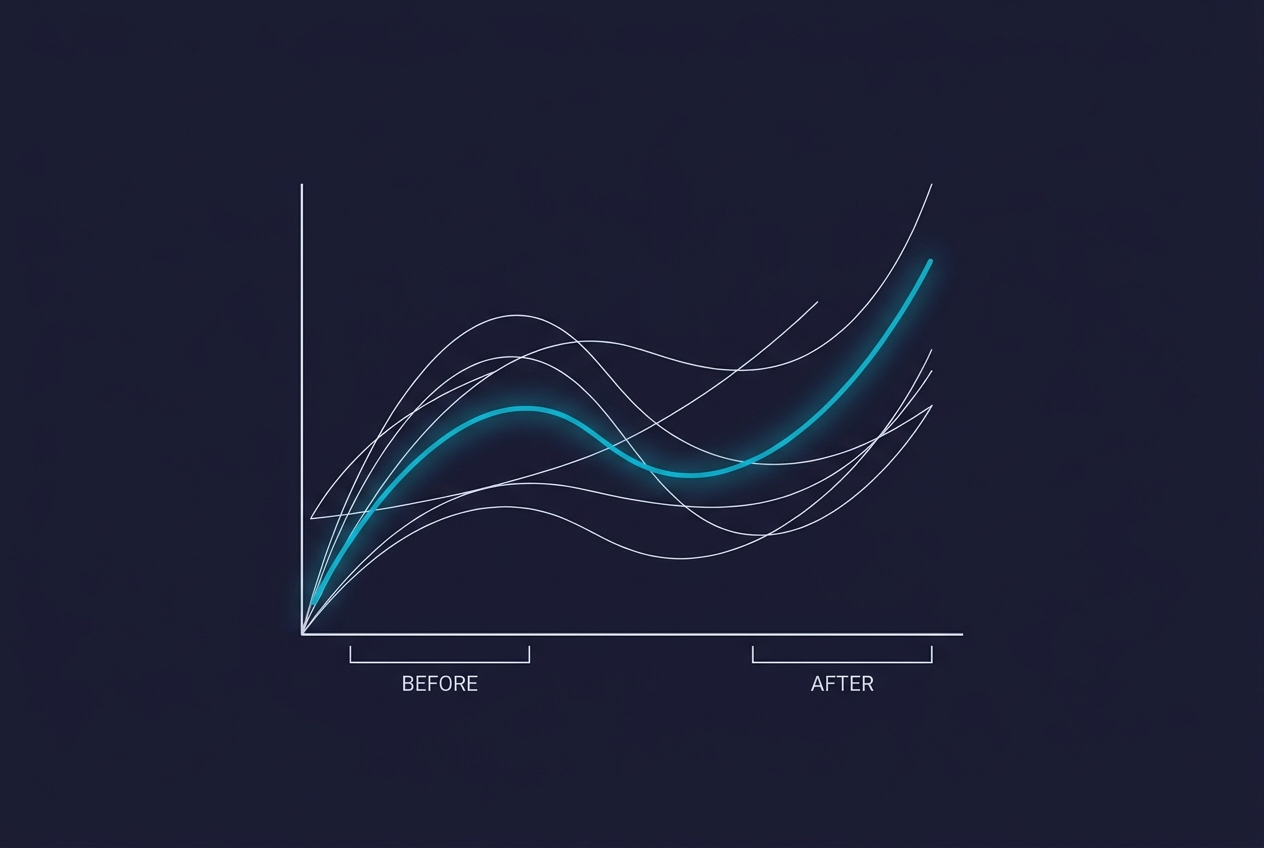
The default evaluation is to turn the tool on, watch average handle time or first-contact resolution, and compare the month after to the month before. This design cannot distinguish the tool's effect from three common confounds:
- Selection. The agents or teams who adopt a new tool first are rarely average. Early adopters tend to be more engaged, which inflates the apparent effect.
- Time trends. If the business was already improving — a new knowledge base, a seasonal easing of volume — the tool inherits credit for gains it did not cause.
- The novelty effect. Behavior changes simply because people know they are being observed or are trying something new. It fades, and a one-month window captures the spike, not the steady state.
Any of these can manufacture a result large enough to justify a purchase that does not hold up once the tool is live everywhere.
The core design: a controlled rollout
The strongest practical design available to most teams is a randomized, staggered rollout. Randomize which agents or teams receive the tool first, holding a comparable group without it as a control for a defined period. Because assignment is random, the two groups share the same time trends, the same seasonality, and the same underlying population — so the difference between them isolates the tool.
Where a true holdout is not politically feasible, a staggered rollout across teams over time gives you a defensible approximation: each team acts as its own before-and-after, and teams that have not yet received the tool serve as a moving control. The analysis technique here is a difference-in-differences — comparing the change in the treated group to the change in the untreated group over the same window.
The question is never "did the metric improve after we turned it on." It is "did the metric improve more for the group that got the tool than for the comparable group that did not, over the same period." Only the second question controls for everything else that was happening.
Choose outcomes you can defend
Real-time assist is pitched against a long list of metrics. Pick a small number you can measure cleanly and connect to money.
- Handle time is the most direct, but be careful: faster is only better if quality holds. Always pair it with a quality or resolution measure so you are not rewarding rushed, unresolved contacts.
- First-contact resolution ties more directly to cost, because repeat contacts are pure waste, but it requires the resolution discipline of a defined window and signal.
- Ramp time for new agents is often where real-time assist earns its keep and is frequently ignored. If new hires reach proficiency faster, the saving is real and measurable against your historical ramp curve.
- Compliance adherence matters most in regulated work, where the value is avoided risk rather than saved minutes — harder to price, but not unmeasurable.
Resist the temptation to claim all of them. A defensible study reports two or three outcomes with honest confidence intervals, not a dashboard of green arrows.
A worked model
Here is an illustrative calculation for a hypothetical 200-seat center. Every input is a modeled assumption, not a measured result; the point is the structure, not the figures.
Assumptions (illustrative)
  Agents                              200
  Contacts / agent / day               40
  Working days / year                 230
  Fully-loaded cost / agent-hour   $   32
  Avg handle time, baseline         6.0 min
  Measured AHT reduction (net)       0.5 min   <- from controlled rollout
  Quality: held flat (verified)

Annual capacity freed
  Time saved / contact              0.5 min
  Contacts / year         200 * 40 * 230 = 1,840,000
  Minutes saved       1,840,000 * 0.5 = 920,000 min
  Hours saved                        15,333 hrs
  Value at $32/hr                 $  490,667

Less: tool cost (illustrative)   $ (180,000)
Net modeled annual value         $  310,667
Two cautions make this honest. First, "capacity freed" is only a cash saving if you actually reduce headcount or absorb growth without hiring; freed minutes that are reabsorbed into slack are real but softer. Second, the 0.5-minute reduction must come from the controlled comparison, not from a raw before-and-after — swap in an inflated, un-controlled number and the whole model inherits the error.
Watch the adoption confound
One confound deserves separate mention because it quietly inflates so many real-time-assist studies: agents have to actually use the tool for it to work, and usage is uneven. If you measure the effect only among heavy users, you are measuring it among the agents most inclined to improve anyway — the selection problem again, wearing a different hat. Treat adoption as a gated input to the ROI, not an afterthought. Report what share of eligible interactions actually invoked the assist, and estimate value on the realistic mix of heavy, light, and non-users you will have in production — not on the enthusiasts who carried the pilot. An effect that is real but concentrated in a fifth of your agents is a different, and smaller, business case than the demo implied.
Reporting the result
Present the effect as a range, not a point. State the design, the control, the window, and the outcomes you did not find an effect on — a study that reports only its wins is advocacy, not measurement. And separate the two kinds of value clearly: hard savings you would book, and softer benefits (ramp, adherence, agent experience) you believe but would not put in a cost case.
Real-time assist can be genuinely valuable. Whether it is valuable for you is an empirical question, and the answer is only as trustworthy as the design that produced it. Spend the effort on the design. The technology will either show an effect that survives it or it will not — and either answer is worth more than a confident number nobody can defend.