
How to build a CX metrics stack that earns executive buy-in
Learn how to align operational CX data with financial outcomes to build a metrics stack that secures C-suite confidence and justifies strategic investment.
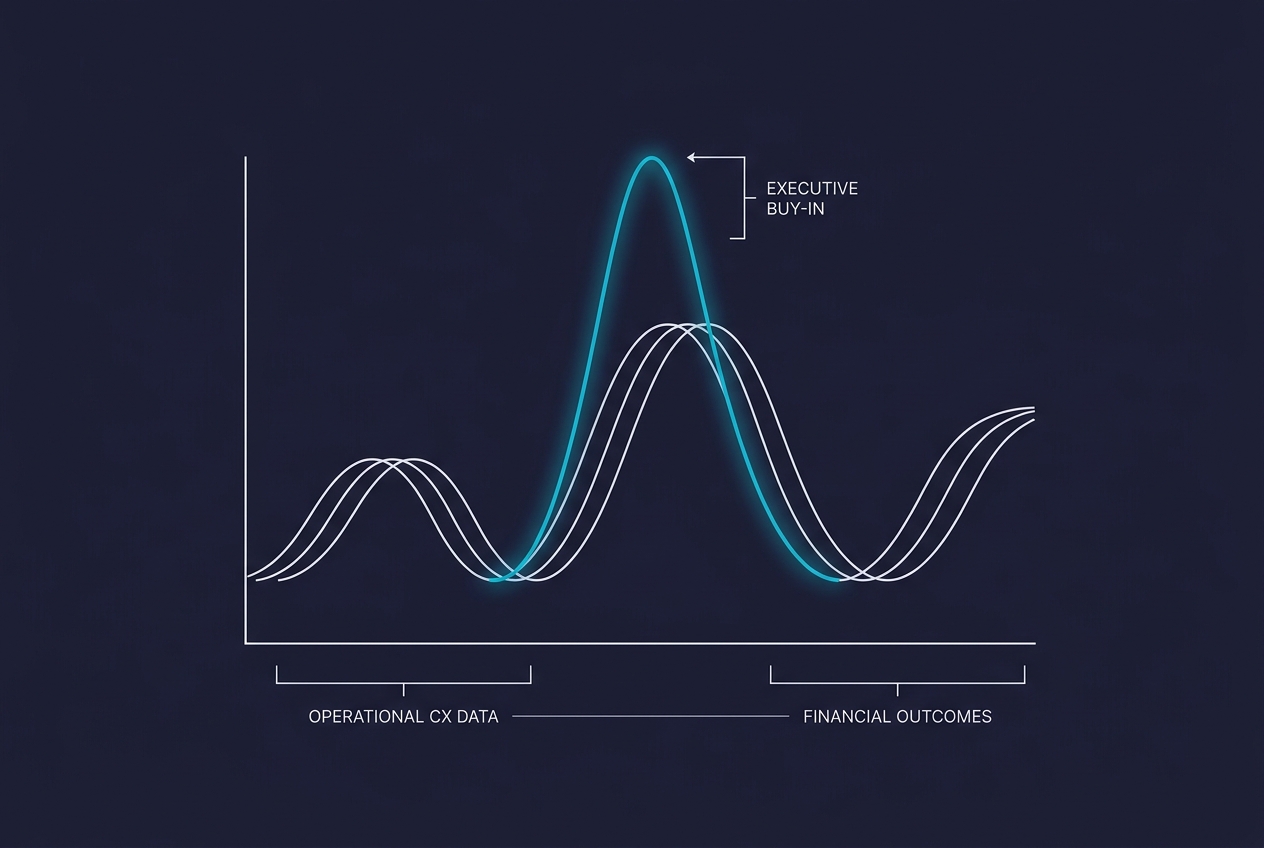
To build a customer experience (CX) metrics stack that executives trust, organizations must bridge the gap between operational activity and financial outcomes. This requires moving away from isolated survey scores and toward an integrated data architecture that links interaction quality, customer sentiment, and long-term business value. A credible stack provides a clear line of sight from a single customer interaction to its eventual impact on retention, revenue, and cost-to-serve.
Key takeaways
- Financial linkage is mandatory: Executives prioritize metrics that correlate directly with churn, lifetime value (LTV), or operational efficiency.
- Shift from perception to behavior: While surveys measure what customers say, behavioral data from platforms like Salesforce or Zendesk reveals what they actually do.
- Total visibility replaces sampling: Modern conversation intelligence allows firms to move beyond small manual samples to analyze 100% of interactions for compliance and sentiment.
- Standardized definitions are the foundation: Trust erodes when different departments use conflicting definitions for the same KPI.
Why CX metrics often fail the executive sniff test
The primary reason CX initiatives struggle to secure budget is a lack of perceived rigor in their measurement. Many programs rely heavily on relational scores—such as those tracked by Forrester’s Customer Experience Index—without connecting those scores to the company's specific financial ledger. When a metric like Net Promoter Score (NPS) rises but revenue stays flat, the metric loses its credibility in the boardroom.
Furthermore, the reliance on manual data entry or small sample sizes creates a margin of error that is often too wide for financial planning. For instance, the case for retiring the 2-percent QA sampling model is built on the reality that a tiny slice of data cannot accurately represent the health of a multi-million-dollar operation. To earn trust, the metrics stack must be rooted in comprehensive, automated data collection rather than anecdotal evidence.
The three-layer architecture of a trusted metrics stack
A robust metrics stack is organized into three distinct layers: Operational, Experiential, and Financial. Each layer serves a different purpose, but they must be technologically linked to provide a complete picture.
1. The Operational Layer (Efficiency and Execution)
This layer tracks the 'how' and 'when' of the customer journey. It includes metrics like average handle time (AHT), first-contact resolution (FCR), and channel volume. These are typically pulled from CCaaS platforms such as Five9, Genesys, or Talkdesk. While these metrics are essential for workforce management, they are 'process' metrics, not 'outcome' metrics. On their own, they rarely excite a CFO.
2. The Experiential Layer (Sentiment and Perception)
This layer captures how the customer felt about the interaction. It involves CSAT, NPS, and Customer Effort Score (CES). To make this layer more robust, leading firms are increasingly using sentiment analysis from providers like Google Cloud AI or specialized layers like Hear.ai to categorize the emotional tone of every call and chat. This converts qualitative feelings into quantitative data points that can be tracked over time.
3. The Financial Layer (Value and Impact)
This is the most critical layer for executive buy-in. It tracks the business results of the previous two layers. Key metrics include churn rate, expansion revenue, cost-to-serve, and customer lifetime value (CLTV). The goal of a high-maturity CX organization is to prove that a 5-point increase in the Experiential layer leads to a measurable reduction in churn in the Financial layer.
Moving from manual samples to total interaction analysis
One of the greatest barriers to trust is the 'sampling bias.' If an executive knows that quality scores are based on a manager listening to three calls per month per agent, they will naturally question the validity of the data. This is where instrumentation before insight: fixing the CX data gap becomes a strategic priority.
By deploying conversation intelligence tools, organizations can analyze 100% of their voice and text interactions. For example, using Hear.ai for compliance monitoring and sentiment mapping allows a firm to say, "We know our compliance risk is down across all 50,000 calls this month," rather than guessing based on a handful of reviews. This level of data density is what allows an analyst to perform regression analysis and find the true drivers of customer loyalty.
How to link CX performance to the bottom line
To align your stack with corporate goals, you must speak the language of the P&L (Profit and Loss) statement. This involves three specific steps:
- Identify the 'Golden Metric': Determine which business outcome the C-suite cares about most this year. Is it reducing the cost of service? Is it increasing retention in a specific market segment?
- Map the Journey: Use your CRM data (e.g., Microsoft Dynamics or Salesforce) to see what happens after a 'poor' experience versus a 'good' one. If customers who report a high effort score are 40% more likely to cancel their subscription within 30 days, you have a financial baseline.
- Calculate the Value of Improvement: If reducing the effort score by 10% saves a specific number of customers, you can put a dollar value on that CX improvement. This turns a 'soft' sentiment goal into a hard revenue-protection goal.
According to Gartner’s Customer Service & Support practice, the trend for 2026 is a move toward domain-specific AI that protects data while providing these deep insights. Organizations that invest in the infrastructure to link these datasets now will be better positioned to justify their AI and headcount budgets in the future.
Standardizing the 'Source of Truth'
Trust is often destroyed by 'metric drift'—where the marketing team’s definition of a 'retained customer' differs from the finance team’s definition. Building a trusted stack requires a centralized data dictionary.
This dictionary should define precisely how metrics are calculated, which data sources are authoritative (e.g., "The CCaaS platform is the source of truth for handle time, but the CRM is the source of truth for customer identity"), and how often the data is refreshed. When everyone agrees on the math, the conversation shifts from 'Is this data right?' to 'What should we do about this data?'
FAQ
What is the most important metric for executive reporting?
There is no single 'most important' metric, but the most effective ones are those that link to financial outcomes, such as Customer Lifetime Value (CLTV) or Churn Rate. Executives value metrics that show a direct impact on the company's bottom line.
How do I handle conflicting data from different departments?
Establish a 'Source of Truth' document that designates specific platforms for specific KPIs. For example, use your CRM for customer health data and your contact center platform for operational efficiency data to ensure consistency across the organization.
Is NPS still relevant for executive buy-in?
NPS remains a common benchmark, but its value in the boardroom is declining unless it is paired with behavioral data. To maintain relevance, show how changes in NPS correlate with actual customer spending or retention patterns.
How can AI improve the credibility of my CX metrics?
AI improves credibility by enabling the analysis of 100% of customer interactions. This eliminates the sampling bias inherent in manual reviews and provides a more accurate, data-driven view of customer sentiment and agent performance.
Building a trusted CX metrics stack is less about finding a 'magic' number and more about creating a transparent, repeatable process that connects the front line to the bottom line. By prioritizing data integrity and financial linkage, CX leaders can transform their departments from cost centers into recognized drivers of enterprise value.
Explore more on how to refine your measurement strategy by reading about choosing the right CX metric.