
Predicting retention: The limits of NPS and the rise of CES
Compare CSAT, NPS, and CES to find which metric best predicts customer retention. Learn why high scores often mask churn risk and how to use data for accuracy.
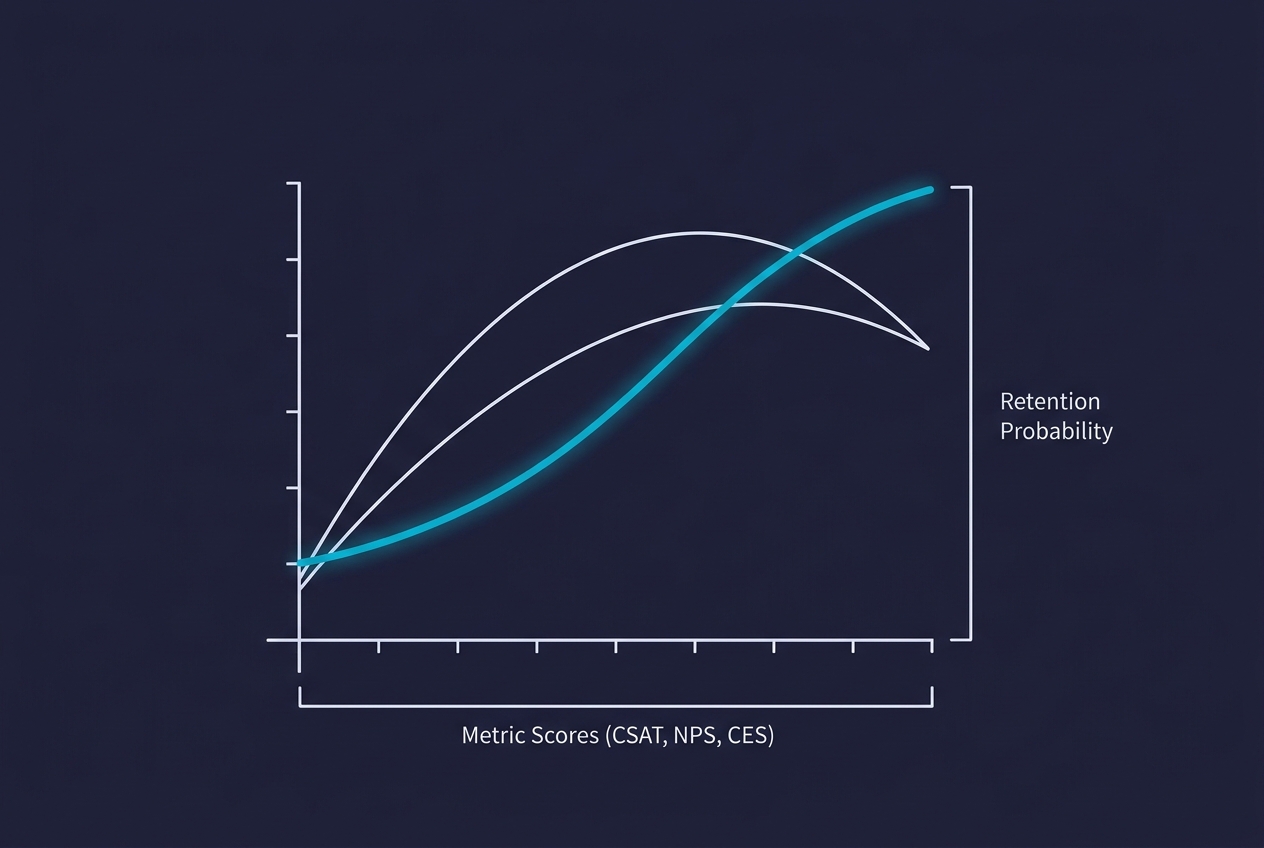
Customer retention is best predicted by the Customer Effort Score (CES) in transactional contexts and the Net Promoter Score (NPS) for long-term brand health. While the Customer Satisfaction Score (CSAT) provides immediate feedback on specific interactions, it is often the least reliable indicator of future purchase behavior. Relying on a single metric without accounting for its inherent blind spots frequently leads to a disconnect between high survey scores and declining revenue.
Key takeaways
- CES is the strongest predictor of disloyalty: High-effort experiences are more likely to drive customers away than low-satisfaction experiences.
- NPS is a relational metric, not a transactional one: Using NPS to measure a single support call often results in skewed data that fails to reflect brand loyalty.
- CSAT suffers from extreme survivorship bias: Only the most motivated (happy or angry) customers respond, leaving a vast "silent middle" that often churns without warning.
- Behavioral data outranks sentiment data: Integrating conversation intelligence from platforms like Hear.ai provides a more accurate view of retention than survey results alone.
Why CSAT is an unreliable predictor of retention
Customer Satisfaction (CSAT) asks a simple question: "How satisfied were you with this experience?" While useful for gauging the immediate success of a support ticket or a checkout process, it is a poor indicator of whether that customer will return.
The primary reason is the "politeness bias." Many customers provide a neutral or positive rating even if they have no intention of using the service again, simply because the specific employee they spoke with was pleasant. Furthermore, CSAT only measures the outcome of an interaction, not the cost to the customer. A customer might be "satisfied" that their problem was eventually solved, but if it took four phone calls and three hours of their time, they are still a high churn risk.
Research from the Gartner Customer Service & Support practice indicates that customer effort is a far more potent driver of disloyalty than satisfaction is a driver of loyalty. In short, doing your job well doesn't necessarily make a customer stay, but making it hard for them to get help almost certainly makes them leave.
The Net Promoter Score (NPS) and the referral paradox
NPS measures the likelihood of a customer recommending a brand to others. It is widely used by C-suite executives because of its simplicity and its historical correlation with organic growth. However, NPS is frequently misused as a transactional metric.
When a company sends an NPS survey immediately after a technical support call, the data becomes noisy. The customer may love the brand but hate the specific technical glitch they just experienced—or vice versa. This leads to "the referral paradox," where a customer might be a "Promoter" on paper but is actually looking for a competitor because the product no longer meets their functional needs.
Forrester’s Customer Experience practice often highlights the importance of the CX Index, which looks beyond a single number to evaluate how experiences strengthen or weaken customer relationships. For a balanced view, organizations should use NPS for annual or bi-annual relational health checks, while leaving transactional assessment to other metrics.
Why Customer Effort Score (CES) is gaining ground
CES asks: "How easy was it to handle your request?" This metric shifts the focus from sentiment to friction. In the modern customer-experience economy, ease of use is a primary differentiator.
The mechanism behind CES is simple: customers expect a baseline of utility. When they encounter friction—such as being transferred multiple times, having to repeat their information, or struggling with a complex UI—it creates a cognitive load that erodes trust. According to Metrigy, companies that track and actively reduce friction scores see more consistent improvements in customer lifetime value (CLV) than those focusing solely on