
CX Agentic AI Implementation: A 2026 Strategic Framework
Learn how to deploy CX agentic AI with this 2026 strategic framework. Master autonomous workflows, cost-to-serve metrics, and risk mitigation for scale.
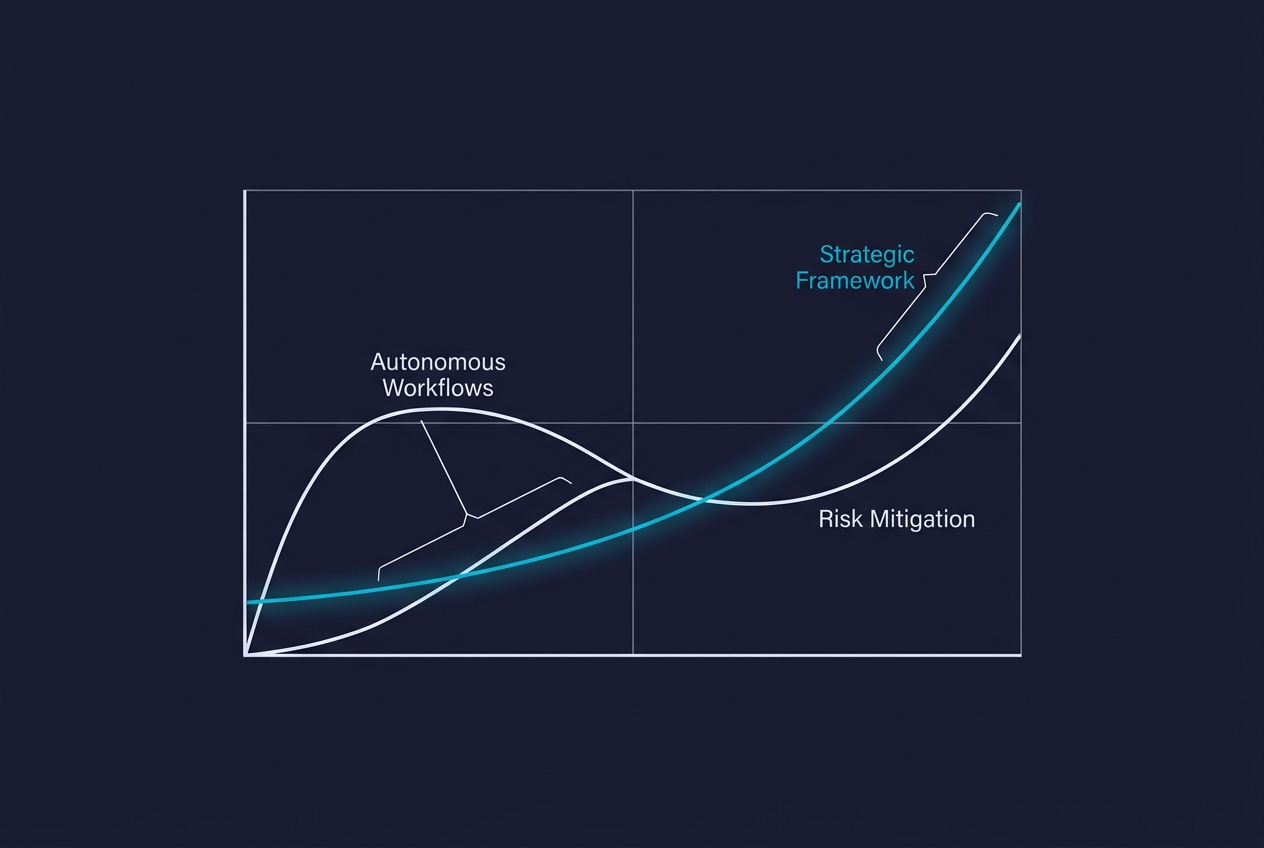
CX agentic AI implementation represents the evolution from simple conversational interfaces to autonomous systems capable of executing multi-step workflows and independent reasoning. In 2026, successful deployment requires a shift from prompt engineering to orchestration, focusing on how AI agents interact with legacy APIs and unstructured data to resolve complex customer inquiries without human intervention. This transition allows organizations to move beyond deflection toward full-resolution automation.
Key takeaways
- Orchestration over interaction: The value of agentic AI lies in its ability to execute tasks—such as processing returns or updating records—rather than just providing answers.
- Data accessibility is the primary bottleneck: High-performance agents require real-time access to clean, vectorized data across CRM and ERP systems.
- Shift in ROI metrics: Organizations are moving away from 'cost-per-interaction' toward 'cost-per-resolution' and 'autonomous success rate.'
- Human-in-the-loop (HITL) evolution: Human roles are shifting from direct responders to 'agent supervisors' who manage exceptions and refine model logic.
What defines agentic AI in the 2026 CX landscape?
Agentic AI is defined by its capacity for autonomous reasoning, planning, and tool utilization to achieve a specific customer goal. Unlike standard generative AI, which primarily focuses on content synthesis, agentic systems can break down a complex request—such as 'I need to change my flight and find a pet-friendly hotel near the new airport'—into discrete sub-tasks. These systems use 'tools' (APIs, databases, and external services) to execute those tasks, evaluating the outcome of each step before proceeding to the next. For leadership, this means the focus of 2026 CX AI Strategic Planning: Scaling Beyond the Pilot Phase must shift toward building robust integration layers that these agents can safely navigate.
How can organizations bridge the gap from pilot to production?
Bridging the gap requires a move from 'black box' prompts to a structured agentic architecture that includes memory, planning, and execution modules. Many early-stage pilots fail to scale because they lack the necessary guardrails to handle edge cases or 'hallucinations' in task execution. To move to production, firms must implement a layered verification system where a secondary model audits the proposed actions of the primary agent before they are committed to the database. This 'reasoning trace' provides the transparency needed for compliance and quality assurance in highly regulated industries.
What are the core components of an agentic AI tech stack?
A modern agentic stack consists of four primary layers: the model layer, the orchestration layer, the integration layer, and the observation layer. The model layer provides the underlying reasoning (LLMs), while the orchestration layer manages the 'loops'—the process by which the AI checks its own work. The integration layer consists of the APIs that allow the agent to affect change in the real world. Finally, the observation layer is critical for Measuring CX Generative AI ROI: A 2026 Financial Framework, as it tracks the efficiency and accuracy of autonomous workflows. Without these four layers, agents remain siloed and unable to deliver the promised operational efficiencies.
A survey of the current vendor landscape
The market for agentic AI solutions includes both established CRM platforms and specialized automation providers. Companies such as Salesforce, Zendesk, Intercom, and Hear.ai offer varying approaches to autonomous agent deployment, ranging from low-code orchestration to integrated data-processing layers. These vendors are increasingly focused on 'agentic builders' that allow CX teams to define the boundaries and tools available to an AI agent without requiring deep software engineering expertise.
How does agentic AI change the CX financial model?
The financial model for CX shifts from a labor-heavy variable cost structure to a technology-heavy fixed cost structure with significantly lower marginal costs per resolution. While the initial investment in agentic AI—covering data cleaning, API development, and model fine-tuning—is higher than traditional chatbots, the long-term ROI is driven by the 'autonomous resolution rate.' In this model, the cost-to-serve drops dramatically as the AI handles the bulk of transactional volume, leaving human agents to focus on high-value, emotionally complex, or high-risk interactions that require empathy and nuanced judgment.
What are the primary risks of autonomous agents in CX?
The primary risks include 'cascading failures,' where an error in an early step of an autonomous workflow leads to a series of incorrect actions, and 'unauthorized tool use,' where an agent might access data or perform actions outside its intended scope. Mitigating these risks requires strict permissioning at the API level and the implementation of 'semantic guardrails' that restrict the agent's reasoning paths. Organizations must also maintain a clear version-control system for their AI agents, ensuring that updates to the underlying model do not break existing autonomous workflows or introduce new biases into the customer experience.
FAQ
What is the difference between Generative AI and Agentic AI in CX? Generative AI focuses on creating text or content based on patterns, while Agentic AI focuses on taking actions and completing multi-step tasks autonomously. While Generative AI answers a question, Agentic AI solves a problem by interacting with other software systems.
How do we measure the success of an AI agent? Success is measured through the 'Autonomous Resolution Rate' (ARR), which tracks the percentage of inquiries resolved from start to finish without human intervention. Other key metrics include 'Mean Time to Resolution' (MTTR) for automated flows and the 'Reasoning Accuracy Score' during the planning phase.
Does agentic AI replace human contact center agents? It shifts the role of human agents from transactional task-takers to 'subject matter experts' and 'AI supervisors.' While it reduces the need for headcount in basic tier-1 support, it increases the demand for skilled professionals who can manage complex exceptions and oversee the performance of the AI systems.
What is the first step in implementing an agentic framework? The first step is identifying 'high-intent, high-structure' workflows—tasks that are common, have a clear beginning and end, and rely on structured data. Starting with a narrow scope, such as order status updates or password resets, allows the organization to test the orchestration and integration layers before moving to more complex, unstructured customer problems.
Explore our deep-dive research into the 2026 CX AI Strategic Planning: Scaling Beyond the Pilot Phase to begin your transition to transition to autonomous service.