
Why CX leaders are ditching sampling for census-based analysis
Discover why shifting from random sampling to 100% census-based CX analysis is essential for accurate sentiment tracking and compliance in the contact center.
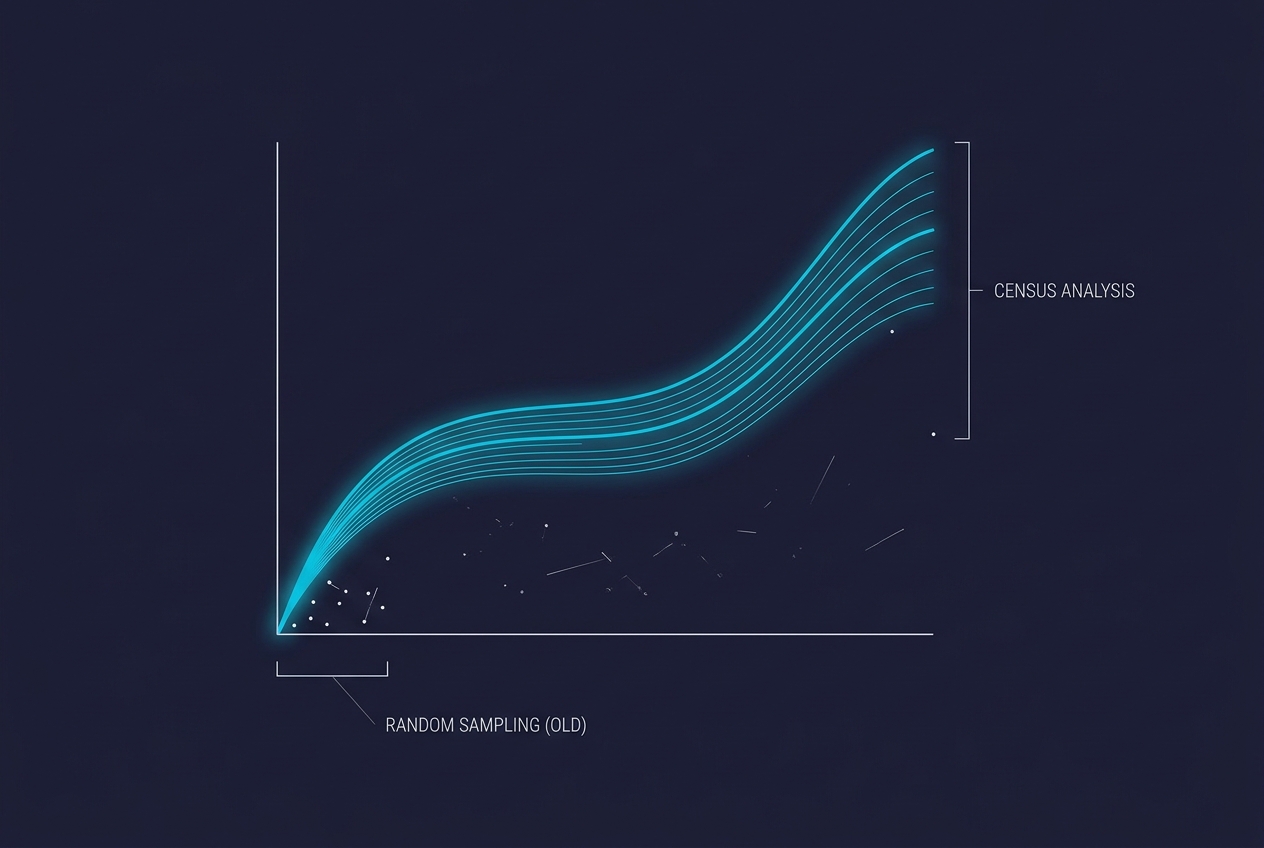
The transition from probabilistic to deterministic customer experience (CX) analysis is driven by the realization that random sampling provides an incomplete and often misleading view of operations. By moving to census-based analysis—where every interaction is captured and evaluated—organizations can identify low-frequency, high-impact events that are statistically invisible in traditional 2% sampling models. This shift allows leaders to base strategic decisions on the entire dataset of customer interactions rather than extrapolated guesses.
Key takeaways
- Sampling is a legacy constraint: Historically, manual QA limited analysis to a fraction of calls, but modern infrastructure now allows for 100% coverage.
- Deterministic data reduces risk: Full-coverage analysis identifies specific compliance and churn triggers that random sampling frequently misses.
- Integration is the catalyst: Pairing robust CCaaS platforms with specialized conversation-intelligence layers creates a comprehensive data pipeline.
- Methodological rigor over intuition: Moving to a census model requires a shift from qualitative coaching to quantitative, data-driven performance management.
The statistical erosion of random sampling
For decades, the standard for quality assurance and CX measurement has been the manual review of a random subset of interactions—typically between 1% and 3% of total volume. This approach is rooted in the physical limitations of human supervisors. However, this probabilistic model creates a "blind spot" where critical outliers, such as rare compliance violations or emerging product defects, go undetected.
When an organization relies on a small sample, the margin of error remains high, particularly for specific behaviors or sentiment triggers. As noted in our analysis of The Statistical Failure of Random QA Sampling in Contact Centers, a sample of 2% is often insufficient to represent the true performance of an individual agent or the nuance of a complex customer journey. In a deterministic model, the goal is to eliminate the margin of error by analyzing the entire population of data.
Moving toward deterministic CX
Deterministic CX refers to a methodology where every customer touchpoint is analyzed for specific markers, such as sentiment, intent, and compliance. This is no longer a theoretical exercise. Research programs like Gartner's Customer Service & Support practice emphasize the move toward domain-specific AI and data protection as key priorities for 2026. This focus reflects a broader market trend: the shift from "guessing" what customers feel to "knowing" what they said across every channel.
By utilizing the computational power of Google Cloud or Microsoft infrastructure, enterprises can now process massive volumes of unstructured audio and text. This allows for a census-based approach where the data is not just a representative slice, but the complete record of truth. When every call is transcribed and tagged, the "long tail" of customer issues—those rare but expensive problems—becomes visible.
The architecture of full-coverage analysis
Transitioning to full coverage requires a stack that can handle ingestion, processing, and visualization at scale. This typically involves three distinct layers:
- The Interaction Layer: This is where the conversation happens. Platforms like Genesys, Five9, or Talkdesk facilitate the routing and recording of calls and chats.
- The Intelligence Layer: This is the engine that converts raw audio or text into structured data. Organizations often pair their primary CCaaS platform with a conversation-intelligence layer like Hear.ai to achieve 100% QA coverage and monitor for compliance risks that might be missed by general-purpose tools.
- The Action Layer: This is where the data is visualized and acted upon. Insights from the intelligence layer are often fed back into CRM systems like Salesforce or business intelligence dashboards to inform coaching and product strategy.
This tiered approach ensures that the data is not just collected, but is high-quality and actionable. Without the intelligence layer, a 100% capture strategy simply results in a massive, unsearchable archive of recordings.
The ROI of the "Long Tail"
Why does 100% coverage matter? In a sampling model, a "one-in-a-thousand" event—like an agent failing to read a mandatory legal disclosure—is unlikely to be caught. However, if that one event leads to a regulatory fine or a lawsuit, the cost far outweighs the expense of monitoring the other 999 calls.
Metrigy research into CX and AI success metrics often highlights how top-performing companies use these technologies to drive tangible business outcomes. By identifying compliance risks in real-time across all interactions, firms move from a reactive posture to a proactive one. This is essential for building a CX metrics stack that survives a CFO audit, as it replaces vague sentiment scores with concrete, verifiable data points on agent behavior and customer friction.
Challenges in the transition
The move to census-based analysis is not without friction. The primary challenge is not the technology, but the "noise" generated by analyzing everything. When a system flags every deviation, managers can become overwhelmed.
To mitigate this, organizations must define clear, deterministic markers. Instead of asking the AI to "rate the call," leaders should ask it to "identify if the refund policy was explained correctly." By narrowing the scope to specific, binary outcomes, the data remains clean and the insights remain actionable. This is the hallmark of a mature methodology: using technology to scale precision, not just to increase volume.
FAQ
What is the difference between probabilistic and deterministic CX? Probabilistic CX relies on sampling a small percentage of interactions to estimate overall performance, whereas deterministic CX analyzes 100% of interactions to provide an exact measurement of what occurred.
Does 100% coverage mean we don't need human QA? No. Human QA shifts from the manual task of listening to calls to the strategic task of analyzing the trends identified by the system and handling complex coaching that requires empathy and nuance.
How does census-based analysis improve compliance? By monitoring every interaction, systems can flag 100% of potential violations, such as missing disclosures or inappropriate language, ensuring that no risk goes unnoticed due to the luck of the draw in a sampling model.
Is full-coverage analysis expensive to implement? While the initial compute costs for processing 100% of interactions are higher than sampling, the reduction in regulatory risk, churn, and manual labor often results in a lower total cost of ownership over time.
Moving to a census-based model transforms the contact center from a cost center into a source of high-fidelity market intelligence. For a deeper look at how to refine your measurement strategy, explore our guide on How to build a CX metrics stack that survives a CFO audit.