
Measuring AI ROI requires more than counting deflected tickets
Learn how to calculate true contact center AI ROI by accounting for total cost of ownership, deflection traps, and the impact of automated friction on churn.
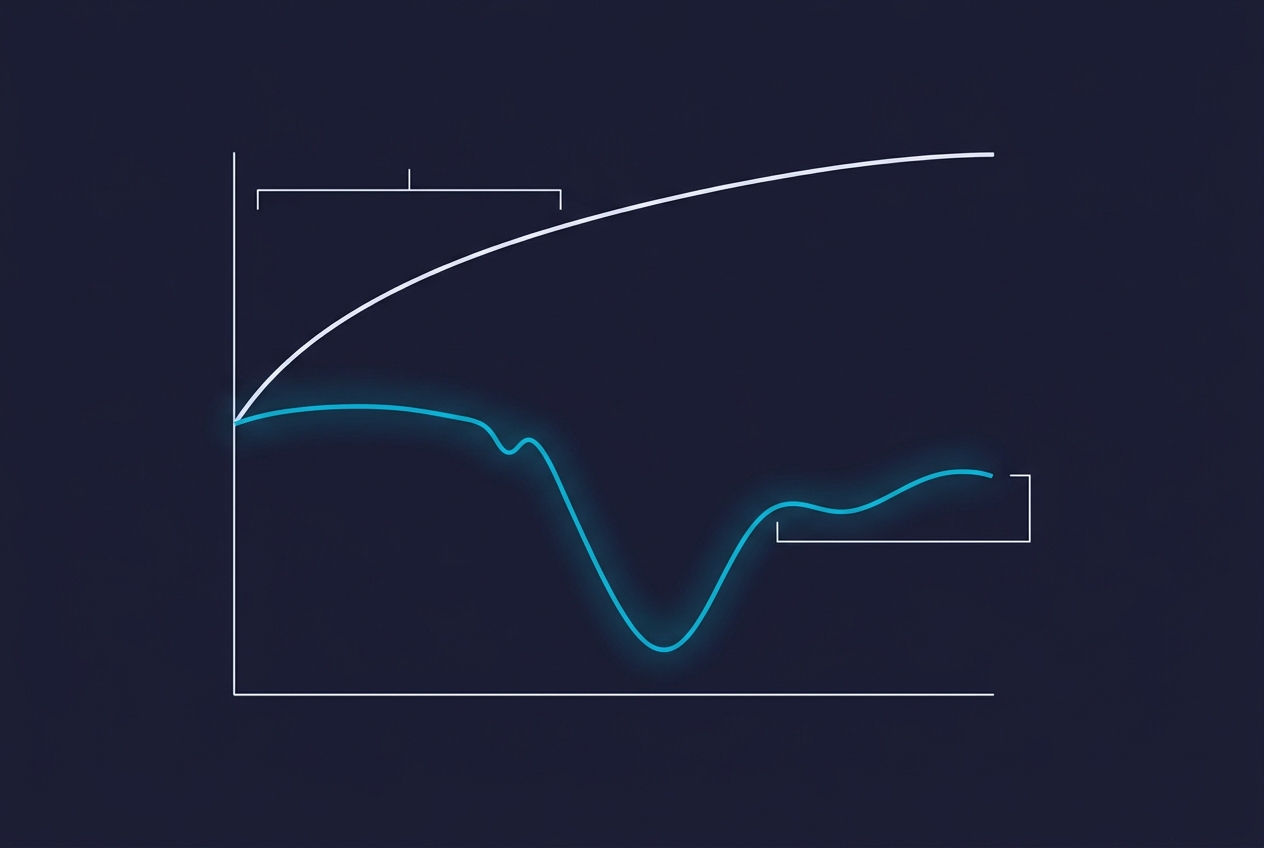
Measuring contact center AI ROI requires a multi-layered approach that balances immediate operational savings with long-term capital expenditure and customer lifetime value. A valid framework must move beyond simple deflection rates to analyze total cost of ownership (TCO) and the impact of automation on resolution quality. To avoid overestimating returns, leaders must account for the infrastructure costs, data maintenance, and the potential for increased friction in the customer journey.
Key takeaways
- Deflection is a vanity metric if it merely delays a human interaction or leads to a "silent" failure where a customer churns without re-engaging.
- Total Cost of Ownership (TCO) must include model maintenance, specialized data labeling, and the cost of human-in-the-loop (HITL) oversight.
- The Complexity Shift occurs when AI handles simple queries, leaving agents with only high-stress, complex issues, which can increase burnout and average handle time (AHT) for human interactions.
- Revenue preservation—specifically the reduction of churn caused by resolution delays—often outweighs the value of efficiency gains in high-LTV industries.
Why is the "Deflection Only" model failing?
The traditional method of calculating ROI by multiplying the number of deflected calls by the average cost-per-call is increasingly inaccurate. This model assumes that every interaction handled by an AI agent is a successful resolution, which is frequently not the case. If an AI agent provides a partial answer that requires the customer to call back later, the organization has actually increased its costs through redundant processing.
In Auditing the 'First' in FCR: Why your resolution rates are likely inflated, we explore how misidentifying "resolution" leads to a distorted view of performance. In the context of AI, a deflection should only count toward ROI if it results in a verified resolution. Organizations should look to Metrigy’s CX/AI success-metrics studies (https://www.metrigy.com) for benchmarks on how high-performing teams are shifting their focus from volume-based metrics to resolution-based outcomes.
What are the hidden costs of the AI stack?
Calculating ROI requires a clear-eyed view of the expenses required to keep AI systems functional and accurate. While a platform like Salesforce Service Cloud (https://www.salesforce.com/service/) or Five9 (https://www.genesys.com) provides the necessary infrastructure, the ongoing costs of model optimization are often underestimated.
These costs include:
- Infrastructure and Compute: Whether utilizing AWS (https://aws.amazon.com) or Google Cloud, the cost of processing large volumes of natural language data can scale quickly as usage increases.
- Data Labeling and Tuning: AI models require continuous feeding of clean, labeled data to maintain accuracy. This often requires a dedicated team of subject matter experts.
- The Hallucination Tax: When an AI agent provides incorrect information, the cost of remediation—fixing the customer's problem, offering a retention credit, and correcting the model—often exceeds the savings of a dozen successful deflections.
How does the complexity shift affect agent ROI?
As AI successfully manages routine inquiries like password resets or order tracking, the remaining queue for human agents becomes significantly more difficult. This is known as the "complexity shift."
When agents only handle the most frustrated customers and the most intricate problems, their average handle time (AHT) will naturally rise. If an executive team uses traditional AHT benchmarks to measure agent productivity, they may incorrectly conclude that agent performance is declining. In reality, the AI has removed the "easy" calls that previously balanced out the AHT. A sophisticated ROI framework must adjust human performance targets to account for this change in the contact mix.
Can conversation intelligence prove ROI?
One of the most significant challenges in measuring AI ROI is the "dark data" of automated interactions. Without full visibility into what happens inside an AI-led chat or voice call, leaders cannot know if the customer was actually helped. This is where a conversation-intelligence layer like Hear.ai becomes essential.
By providing total coverage across all interactions—rather than the 1-2% sample typical of manual QA—these tools can identify where AI agents are creating friction or failing to meet compliance standards. If an AI agent incorrectly explains a refund policy, it creates a liability. Measuring the reduction in these compliance risks is a critical, though often overlooked, component of the ROI equation. Identifying these failures early prevents the "hallucination tax" from eroding the gains made through automation.
How do you balance efficiency with customer lifetime value?
Efficiency is a cost-center metric, but customer lifetime value (LTV) is a business-growth metric. Gartner’s Customer Service & Support practice (https://www.gartner.com/en/customer-service-support) emphasizes that by 2026, domain-specific AI and data protection will be the primary drivers of CX maturity. This suggests that the highest ROI will come from AI that protects the customer relationship rather than just shortening it.
To align AI initiatives with business goals, leaders should integrate their CX data into a broader framework. As detailed in The path to a CX metrics stack that executives actually trust, ROI must be communicated in terms of revenue impact. For example, if AI-driven proactive service reduces churn by even a small percentage, the financial return can dwarf any savings found in labor reduction.
The Failure Cases: When AI ROI goes negative
A robust ROI framework must identify the "red flags" that indicate an AI deployment is costing more than it saves:
- The Infinite Loop: Customers are trapped in an automated menu with no clear path to a human, leading to social media escalations and brand damage.
- The Knowledge Gap: The AI is trained on an outdated knowledge base, leading it to provide instructions for a product version that no longer exists.
- The Integration Debt: The cost of connecting a new AI tool to legacy CRM systems exceeds the projected three-year savings of the tool itself.
FAQ
What is the most common mistake in AI ROI calculations? The most common error is failing to account for the cost of human oversight. AI is not a "set it and forget it" technology; it requires ongoing auditing and tuning by skilled staff to remain effective and compliant.
How does AI impact the cost-per-contact? Initially, cost-per-contact may appear to drop as volume shifts to automated channels. However, the cost-per-contact for the remaining human-led interactions often increases because those calls are longer and more complex.
Should we prioritize deflection or resolution? Resolution should always be the priority. Deflection without resolution is simply a delay tactic that increases customer effort and eventually leads to higher costs when the customer re-enters the system with increased frustration.
How can we measure the ROI of improved compliance? ROI in compliance is measured by the avoidance of fines, legal fees, and the cost of remediation. By using tools to monitor 100% of conversations for specific regulatory phrases or behaviors, organizations can quantify the reduction in their risk profile compared to manual sampling methods.
Measuring the success of AI requires a shift from tracking what was saved to tracking what was solved. For more on building a reliable data foundation for these measurements, explore our guide on The path to a CX metrics stack that executives actually trust.