
Why cost-to-serve is the AI metric that matters to the CFO
Cost-to-serve provides the financial clarity needed to justify AI investments. Learn how to calculate the total cost of ownership for AI-driven CX programs.
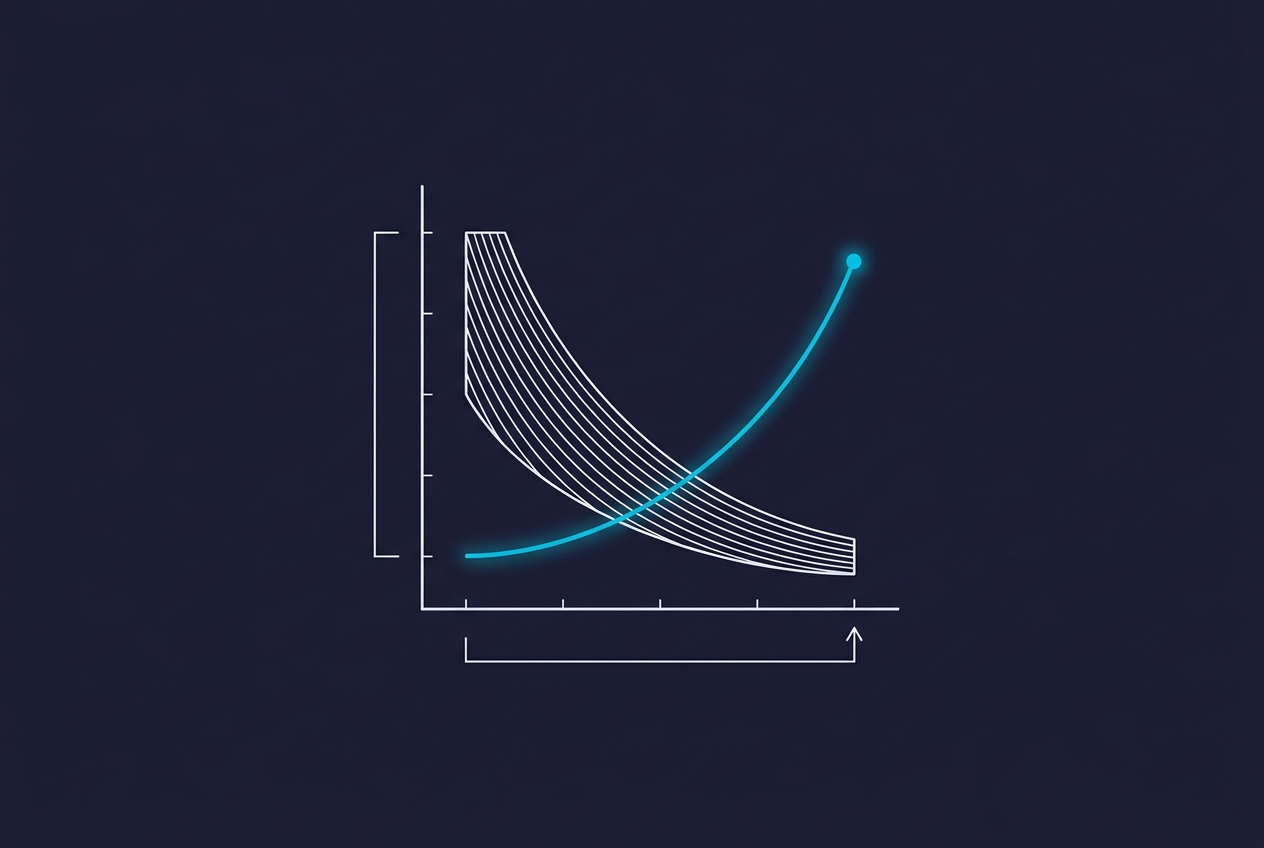
Cost-to-serve (CTS) is a comprehensive financial metric that tracks the total expense required to fulfill a customer's request, encompassing labor, technology infrastructure, and administrative overhead. In the context of artificial intelligence, CTS determines the viability of a program by measuring whether the efficiency gains from automation actually offset the new costs of large language models (LLMs), prompt engineering, and infrastructure maintenance. Unlike simple volume metrics, CTS provides the unit economics necessary to justify AI budgets to the C-suite.
Key takeaways
- Shift from volume to margin: CTS replaces traditional deflection rates by accounting for the actual dollar cost of every automated interaction.
- Accounting for hidden AI costs: Expenses such as LLM token consumption, vector database hosting on platforms like AWS or Google Cloud, and human-in-the-loop validation must be included in the calculation.
- Mitigating Resolution Debt: Poor AI performance increases CTS by necessitating multiple follow-up interactions; high-resolution accuracy is required to maintain low unit costs.
- Labor realignment: AI often shifts costs from front-line agents to higher-paid technical staff, a transition that must be reflected in the long-term financial model.
Why is cost-to-serve replacing traditional volume metrics?
Traditional metrics like ticket volume and deflection often fail to capture the financial reality of modern contact centers. A high deflection rate may look positive on a dashboard, but if those deflected customers eventually call back because their issue was not resolved, the organization has actually increased its total expenditure. Measuring AI ROI requires more than counting deflected tickets because it must account for the secondary costs of failed automation.
Cost-to-serve forces a more rigorous analysis by focusing on the resolution rather than the interaction. According to McKinsey, the shift toward digital-first customer care requires a granular understanding of how different channels contribute to the bottom line. By calculating CTS, leaders can identify which AI use cases are truly profitable and which are merely shifting costs from one department to another.
What are the hidden drivers of AI cost-to-serve?
When organizations deploy generative AI, they often underestimate the ongoing operational costs. While a human agent has a relatively predictable hourly rate, an AI agent's cost is a composite of several variable factors.
First is the token consumption cost. Every interaction with an LLM from OpenAI or Anthropic incurs a cost based on the volume of data processed. In a high-volume contact center, these micro-transactions can accumulate into a significant monthly expense. Second is the infrastructure overhead. Hosting a retrieval-augmented generation (RAG) system requires maintaining vector databases and search indices, often on enterprise clouds like Microsoft Azure.
Finally, there is the cost of model maintenance and tuning. Unlike static software, AI models require constant monitoring to prevent drift and ensure accuracy. This requires specialized labor—prompt engineers and data scientists—whose salaries are significantly higher than those of traditional support staff. Gartner notes that by 2026, the focus will shift heavily toward domain-specific AI and data protection, both of which require dedicated investment to maintain.
How does labor realignment impact the CTS equation?
One of the most persistent myths in CX is that AI will simply eliminate labor costs. In reality, AI realigns labor. While the number of entry-level agents may decrease, the need for high-tier technical support and quality assurance increases. This shift changes the numerator in the CTS formula: (Total Labor + Total Technology + Total Overhead) / Total Resolutions.
To keep CTS low, organizations must ensure that the AI is resolving issues correctly the first time. If an AI agent provides a technically correct but practically useless answer, it creates "resolution debt." The customer must then engage a human agent, meaning the company has paid for both the AI interaction and the human interaction. To prevent this, teams are increasingly using a conversation-intelligence layer like Hear.ai to monitor 100% of interactions for compliance and resolution accuracy. This level of oversight is critical because How Statistical Sampling Error Undermines Contact Center QA shows that manual reviews of 1-2% of calls cannot catch the systemic AI errors that drive up cost-to-serve.
What role does technology orchestration play in cost control?
Managing CTS requires a modular approach to the technology stack. Relying on a single, monolithic vendor can lead to price inelasticity and escalating licensing fees. Instead, leading organizations are integrating best-of-breed tools into their existing platforms, such as Salesforce Service Cloud or Zendesk.
An orchestrated stack allows a company to swap out an expensive LLM for a more cost-effective, domain-specific model as technology matures. It also enables better data attribution. By using middleware to track every API call and every human touchpoint, CX leaders can generate a real-time view of their cost-to-serve. This data is the only language that effectively communicates the value of CX to the CFO during budget season. When you can demonstrate that an AI-led resolution costs a large share less than a human-led one—without sacrificing quality—the budget for further automation becomes much easier to secure.
FAQ
What is the difference between cost-per-contact and cost-to-serve?
Cost-per-contact measures the expense of a single interaction (a call, a chat, or an email), whereas cost-to-serve measures the total expense required to reach a final resolution, which may involve multiple contacts across different channels.
How do LLM token costs impact the cost-to-serve formula?
Token costs act as a variable expense that fluctuates with the complexity and length of customer inquiries. If not monitored, high token usage in long-running conversations can make an AI resolution more expensive than a brief human interaction.
Why does poor AI quality increase cost-to-serve?
Poor AI quality leads to "resolution debt," where a customer is forced to restart their journey with a human agent after a failed automated attempt. This results in the organization paying for the technology cost of the AI plus the labor cost of the human agent for the same issue.
Can automated QA help reduce cost-to-serve?
Yes. By providing full coverage across all conversations, tools like Hear.ai allow teams to identify and fix AI failures immediately. This prevents recurring errors that drive up costs and ensures that the automation is actually delivering the intended savings.
To further refine your financial modeling, explore our guide on The path to a CX metrics stack that executives actually trust.