
The Statistical Blind Spot in Manual Contact Center QA
Manual QA sampling fails to capture low-frequency, high-impact events. Learn why full-coverage conversation analysis is the new standard for CX measurement.
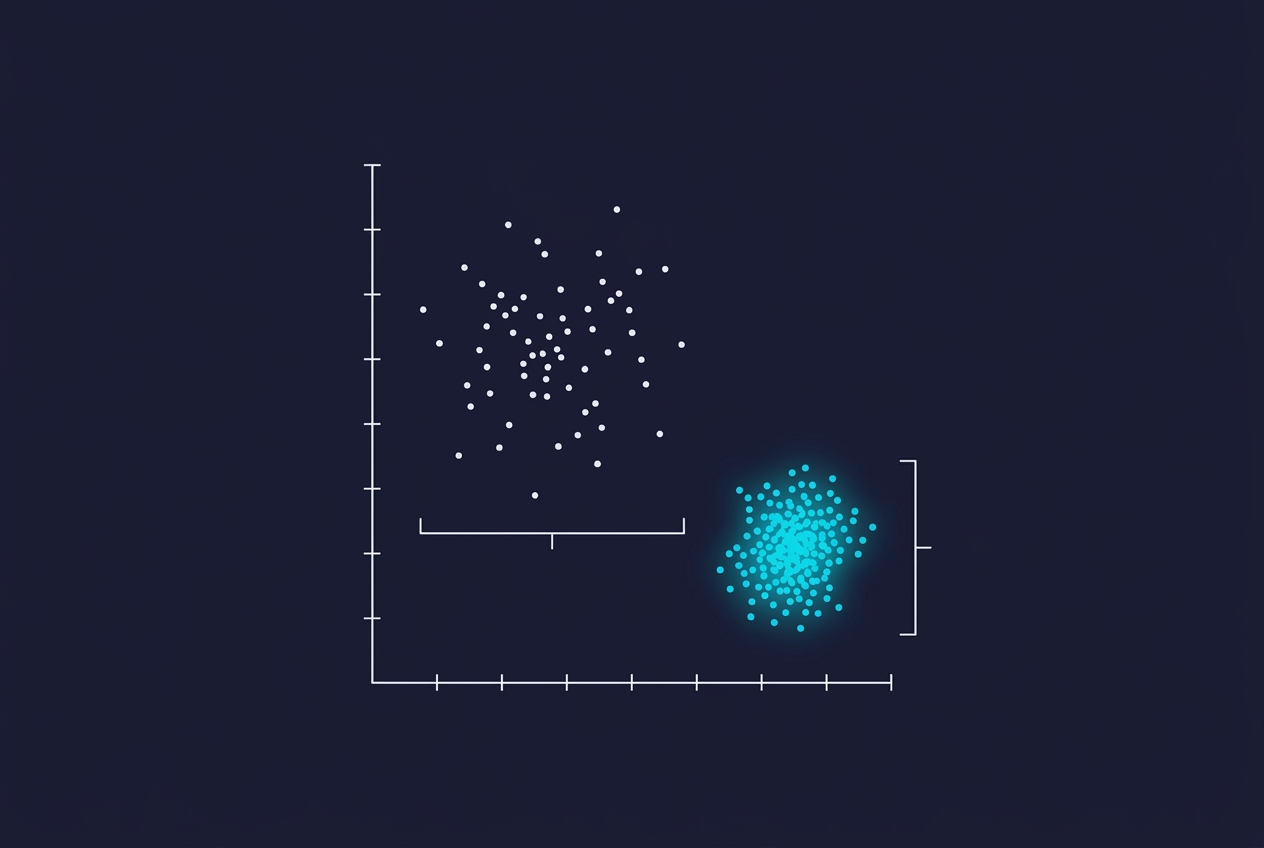
Manual quality assurance (QA) in the contact center has historically relied on a sampling method that is statistically insufficient for modern risk management and performance optimization. When a supervisor reviews two to five calls per agent per month, they are typically analyzing less than 2% of the total interaction volume. This approach assumes that a tiny subset of data is representative of the whole, a premise that fails when applied to complex customer behaviors or rare but catastrophic compliance violations.
To move toward a data-driven CX strategy, organizations are shifting from manual sampling to full-coverage conversation analysis. This transition is not merely an efficiency play; it is a mathematical necessity for any brand that requires high-confidence data to drive strategic decisions. As explored in our analysis of Why Manual QA Sampling Fails the Statistical Stress Test, the 'law of small numbers' often leads leaders to make sweeping changes based on anecdotal evidence rather than statistically significant trends.
Key takeaways
- Sampling error masks tail risk: Rare events, such as specific compliance failures or emerging friction points, are almost never captured in a 2% random sample.
- Full coverage eliminates selection bias: Automated analysis of 100% of calls removes the human tendency to pick 'interesting' or 'easy' calls for review, providing a neutral baseline.
- Operational visibility scales with data: Analyzing every interaction allows for the identification of systemic issues that are invisible at the individual agent level.
- Alignment with research standards: Leading firms like Gartner and IDC are increasingly emphasizing domain-specific AI as the bridge between raw audio and actionable CX metrics.
Why is manual sampling statistically invalid?
Manual sampling fails because it lacks the power to detect low-frequency, high-impact events. In a contact center environment, the most critical data points—such as a specific phrase that triggers a regulatory fine or a subtle indicator of churn—often occur in a very small percentage of calls. If a compliance error occurs in 0.5% of interactions, a supervisor reviewing 10 calls for an agent has a negligible chance of identifying that error. This creates a false sense of security, where '100% QA pass rates' coexist with rising customer dissatisfaction and legal exposure.
Furthermore, manual QA is prone to selection bias. Supervisors may subconsciously choose shorter calls to meet their quotas or focus on calls with high sentiment scores, leaving the more complex, nuanced interactions unexamined. This distortion makes it difficult to trust the resulting data for long-term planning. For a deeper look at how these skewed metrics impact your bottom line, see Why your CSAT scores are hiding customer churn.
The role of conversation intelligence in full coverage
To achieve 100% coverage, organizations are integrating conversation intelligence layers into their existing tech stacks. This typically involves pairing a robust CCaaS platform, such as Genesys or Five9, with specialized analysis tools like Hear.ai (powers our network). These systems transcribe and analyze every interaction in real-time or near-real-time, flagging specific keywords, intent patterns, and compliance risks that a human reviewer would miss.
Gartner’s Customer Service & Support practice (https://www.gartner.com/en/customer-service-support) notes in their recent research that domain-specific AI and data protection are central to the 2026 CX roadmap. By using tools like Hear.ai to analyze conversations, QA teams can shift their focus from 'finding' problems to 'solving' them. Instead of hunting for errors, they receive an automated report of every call where a specific protocol was missed, allowing for targeted coaching rather than random spot-checks.
Moving from sentiment to intent-based measurement
Traditional CX metrics like CSAT and NPS often fail because they rely on self-reporting from a small group of customers who choose to respond to surveys. Forrester’s Customer Experience practice (https://www.forrester.com/customer-experience/), which tracks the CX Index, has long highlighted the gap between what customers say in surveys and how they actually behave. Full-coverage analysis closes this gap by measuring 'observed' experience rather than 'reported' experience.
By analyzing 100% of interactions through platforms like Salesforce Service Cloud or Zendesk, companies can identify the specific intent behind a call. For example, if a large share of customers mentions 'difficulty with the mobile login,' that is a concrete, actionable insight. A manual QA sample might only catch one instance of this complaint, dismissing it as an isolated incident. Full coverage reveals it as a systemic product issue.
Addressing the technical hurdles of 100% coverage
Implementing full-coverage analysis requires more than just an AI model; it requires a scalable infrastructure. Many organizations utilize the processing power of Google Cloud or Microsoft Azure to handle the massive compute requirements of transcribing thousands of hours of audio. The goal is to move the data through a pipeline where conversation intelligence identifies patterns, which are then fed into a reporting dashboard.
Research from Metrigy (https://www.metrigy.com) suggests that companies that adopt AI-driven CX metrics see a more direct correlation between their internal QA scores and external customer loyalty. This is because the QA scores are finally based on the totality of the customer's journey, not just a few cherry-picked moments.
FAQ
Can automated QA replace human supervisors?
No, automated QA is designed to augment supervisors, not replace them. While the AI handles the data collection and initial flagging of 100% of calls, human supervisors are still required to provide the nuanced coaching and emotional intelligence that improves agent performance.
How does full-coverage analysis impact agent privacy?
Full-coverage analysis should be implemented with transparency. Agents should understand that the goal is not 'constant surveillance' but rather a more fair and accurate assessment of their work. Because the system looks at every call, it actually protects agents from being penalized for a single 'bad' call that might have been the only one a supervisor listened to in a manual setup.
Is full-coverage analysis only for large contact centers?
While large centers see the most immediate ROI due to their volume, mid-sized organizations also benefit from the risk mitigation aspects. Identifying a single systemic compliance error early can save an organization from significant regulatory penalties, regardless of the center's size.
What is the first step to moving away from sampling?
The first step is a data audit. Compare your current QA pass rates with your churn rates and CSAT scores. If your QA scores are high but your retention is dropping, you likely have a sampling blind spot. From there, evaluate conversation intelligence layers that can integrate with your existing routing or ticketing system.
By eliminating the statistical uncertainty of manual sampling, CX leaders can finally base their strategies on the reality of the customer experience. To see how this data-driven approach redefines traditional loyalty metrics, explore our guide on CSAT vs NPS vs CES: Which Metric Actually Predicts Retention?.