
Is Your QA Sample Lying? The Math Behind 100% Conversation Audit
Traditional contact center QA sampling creates high statistical variance and masks operational risk. Discover why full-coverage conversation analysis fixes it.
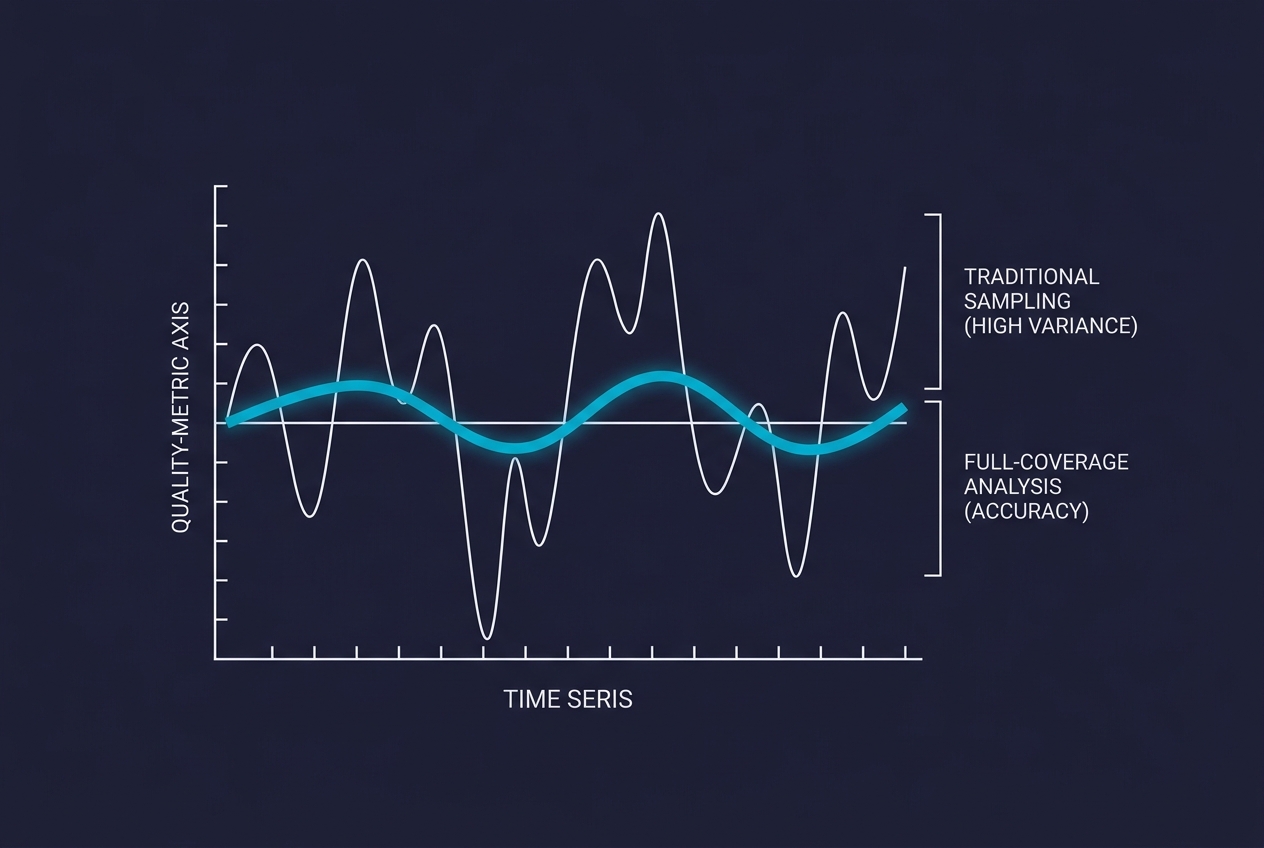
Traditional contact center quality assurance (QA) relies on manually evaluating 1% to 2% of total interaction volume. Statistically, auditing five calls out of a representative agent's monthly workload yields a confidence interval so wide that individual performance scores become volatile and unreliable. Transitioning from manual sampling to full-coverage conversation analysis eliminates statistical sampling error, allowing organizations to monitor compliance, agent adherence, and customer intent across 100% of customer interactions.
Key takeaways:
- Small sample sizes guarantee high variance: Auditing 2% or less of an agent's monthly interactions creates a margin of error exceeding ±30% at standard confidence levels.
- Tail risks remain invisible: Critical compliance failures and churn-inducing agent behavior occurring in 1% of calls are mathematically probable to escape detection under random sampling.
- Full-coverage analysis turns unstructured audio into structured data: Speech-to-text models combined with automated evaluation frameworks assess every call, text, and chat instantly.
- Human evaluators pivot to strategic coaching: Replacing manual scoring with automated baseline audits frees QA teams to focus on root-cause analysis and complex edge cases.
Why does traditional QA sampling fail statistically?
Traditional contact center QA relies on small-sample inspection derived from manufacturing quality control models. However, while industrial assembly lines feature highly standardized outputs, human conversations contain infinite linguistic, emotional, and procedural variations.
When a QA analyst evaluates 4 to 6 randomly selected calls per agent per month out of an average monthly volume of 300 to 500 calls, they are taking a sample size ($n$) of approximately 1% to 2%.
Applying standard binomial distribution math demonstrates why this sample size fails. Assuming an agent's true underlying compliance rate on a specific script disclosure is 90% across 400 monthly calls ($N=400$):
- A random sample of $n=5$ calls yields a standard error that produces an extremely wide 95% confidence interval.
- If the agent misses the disclosure on just one sampled call, their measured compliance score drops from 100% to 80%.
- If they happen to miss two sampled calls, their score plummets to 60%.
In practice, month-over-month fluctuations in an agent's QA scorecard frequently reflect simple sample variance rather than an actual shift in agent skill or compliance adherence. This statistical noise leads management to penalize high-performing agents who suffered an unlucky sample draw, while underperforming agents whose errors went unsampled receive false clean bills of health.
What are the operational risks of unmonitored tail events?
Beyond score inaccuracy for individual agents, small-sample QA creates severe structural vulnerabilities at the enterprise level. Low-frequency, high-severity events—such as failure to recite mandatory financial disclosures, improper identity verification, or abusive language—typically occur in a small fraction of total calls.
If a compliance breach occurs on 1% of incoming calls, a QA program auditing 1% of volume randomly has less than a 2% chance of catching that specific breach in a given month. The remaining 98% of violations pass directly into operational and legal exposure.
Probability of missing a 1%-incidence violation:
  Sample size (n=5):   ~95.1% chance missed
  Sample size (n=10):  ~90.4% chance missed
  Sample size (n=50):  ~60.5% chance missed
  Full Coverage (100%): 0.0% chance missed
This structural blind spot also distorts wider customer experience strategy. As detailed in our research on why CSAT and NPS fail to predict customer retention, aggregate customer satisfaction metrics routinely obscure silent operational failures. When systemic process bottlenecks or misinformed agent responses occur outside the audited 1% sample, operational leaders remain unaware of the primary drivers of customer churn until revenue degrades.
According to research parameters outlined in the Gartner Customer Service & Support practice, enterprise contact centers are increasingly shifting away from sample-based monitoring toward domain-specific automated evaluation to mitigate operational risk and protect customer data.
How does full-coverage conversation analysis work?
Full-coverage conversation analysis replaces random sampling by running 100% of recorded interactions through an automated processing pipeline. The pipeline converts unstructured conversational audio and digital transcripts into structured operational data.
+-----------------------+     +-----------------------+     +-----------------------+     +-----------------------+
|  Raw Audio / Chat     |     |  Transcription &      |     |  Automated QA &       |     |  Analytics & Coaching |
|  (CCaaS Infrastructure| --> |  Diarization Engine   | --> |  Rule Evaluation      | --> |  Dashboards           |
|  e.g., Five9, Genesys)|     |  (Speech-to-Text)     |     |  (e.g., Hear.ai)      |     |  (100% Coverage)      |
+-----------------------+ +-----------------------+ +-----------------------+ +-----------------------+- Audio Ingestion and Diarization: Modern contact center infrastructure, including cloud platforms like Genesys or Five9, streams raw interaction audio into speech-to-text engines. Speaker diarization separates the agent channel from the customer channel.
- Automated Rule and Natural Language Processing: The structured transcript is evaluated against defined quality criteria, including required verbiage, sentiment trajectory, non-talk time, cross-talk, and solution accuracy.
- Specialized Intelligence Layers: Organizations frequently pair their core CCaaS routing with specialized analytics platforms. Teams pair a CCaaS platform like Five9 with a conversation-intelligence layer such as Hear.ai to maintain total QA coverage, evaluate complex multi-turn compliance logic, and automatically flag high-risk calls for human escalation.
- Unified Scorecards: Every completed call receives an immediate scorecard, populating supervisor dashboards in real time rather than weeks after the interaction occurred.
By moving the initial scoring layer from human ears to computational algorithms, variance drops to zero: the same conversation evaluated twice yields identical analytical results.
How do human evaluators fit into a 100% automated audit model?
Transitioning to full-coverage automated evaluation does not eliminate the need for human QA staff. Instead, it reallocates human labor from repetitive administrative scoring to high-value coaching and strategic investigation.
In a manual sampling model, a QA manager spends up to 80% of their working hours listening to routine calls to fill out check-box scorecards, leaving only 20% of their time for agent coaching.
In an automated full-coverage model, the operational breakdown flips:
- Automated Engine (100% Volume): Scores routine compliance, verifies mandatory statements, measures acoustic features (silence, interruptions), and tags customer intent.
- Human QA Team (Targeted Volume): Evaluates interactions flagged by the system as statistical outliers—such as conversations with sudden sentiment drop-offs, highly complex escalations, or conflicting rule results.
This hybrid framework aligns with the principles in our guide on how to build a high-fidelity CX measurement framework, ensuring that human analytical capacity is deployed precisely where ambiguity is highest.
Industry benchmarks tracked by programs such as Metrigy show that contact centers adopting automated interaction evaluation achieve broader operational visibility while simultaneously improving the targeted effectiveness of supervisor coaching sessions.
FAQ
Why can't contact centers simply increase manual QA sampling to 10%?
Increasing manual sampling from 1% to 10% requires a tenfold increase in QA staffing costs, making it financially unviable for most operations. Furthermore, even a 10% sample leaves 90% of interactions unexamined, retaining significant statistical sampling error and leaving major compliance blind spots intact.
Does 100% automated QA scoring replace human QA evaluators?
No. Automated QA handles baseline measurement, rule verification, and anomaly detection across all interactions. Human evaluators shift their focus from routine call scoring to reviewing complex edge cases, validating algorithm accuracy, and delivering personalized, data-backed coaching to agents.
How do speech recognition errors impact automated QA accuracy?
Modern speech-to-text engines tailored for customer service achieve high word-accuracy rates. However, robust conversation analysis tools rely on contextual semantic understanding and acoustic modeling rather than exact keyword matching alone, minimizing the impact of occasional transcription errors on overall QA scores.
What happens to agent engagement when switching to full-coverage audit?
Agent sentiment generally improves when the transition is managed transparently. Because automated QA eliminates the statistical randomness of small-sample evaluations, agents are scored objectively on their actual overall performance rather than penalized for a single unrepresentative call.
To build a complete, objective view of your contact center operations, explore our technical guides on CX measurement architecture and AI implementation strategies.